
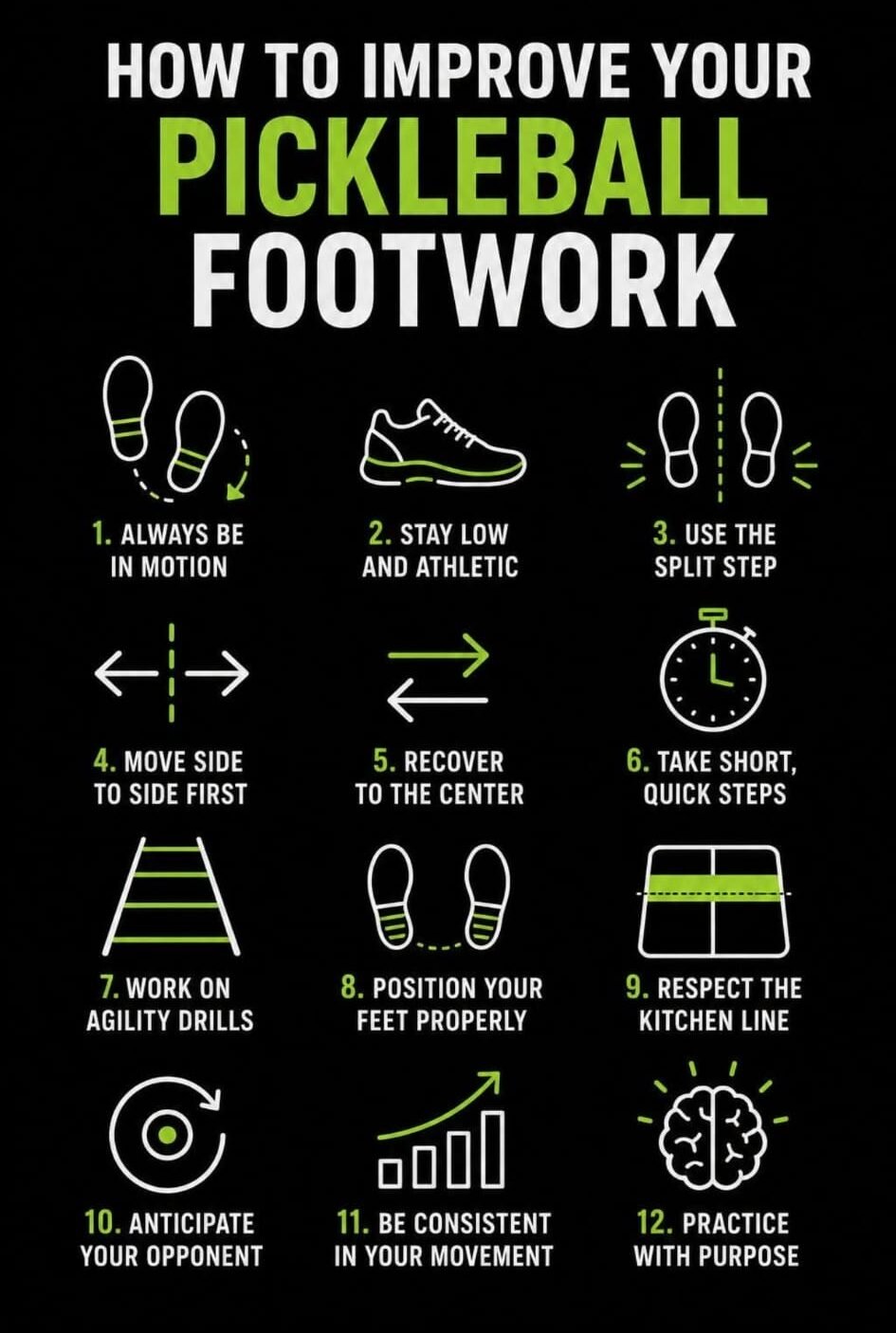
In pickleball, great shots start from the ground up. Exceptional paddle control means very little if you are caught off-balance or struggling to reach the ball in time. Elevating your movement efficiency allows you to set up early, strike with power, and stay in control of high-speed rallies. Here are 12 essential footwork rules to master.
1. Always Be in Motion
Never stand completely still during a point. Keep soft pressure on the balls of your feet and maintain active micro-adjustments so your nervous system is ready to launch in any direction.
2. Stay Low and Athletic
Lower your center of gravity by bending at your knees rather than your waist. A stable, athletic base improves balance, reaction timing, and power transfer.
3. Use the Split Step
Time a slight hop onto the balls of both feet right as your opponent contacts the ball. The split step neutralizes your momentum, allowing you to react instantly to any shot direction.
4. Move Side to Side First
Prioritize lateral shuffle steps along the non-volley zone line rather than turning and running back and forth. Lateral movement keeps your hips squared to the net.
5. Recover to the Center
After being pulled wide or forced off-court to retrieve a ball, immediately recover back toward your home court position to cover vulnerable open angles.
6. Take Short, Quick Steps
Avoid taking huge, clumsy strides or lunging when approaching the ball. Small adjustment steps let you set up precise contact points while maintaining full balance.
7. Work on Agility Drills
Incorporate ladder drills, cone shuffles, and shadow-footwork sessions into your off-court training routine to build quickness and muscle memory.
8. Position Your Feet Properly
Establish a firm, wide base prior to executing your stroke. Striking the ball from a grounded posture dramatically increases shot repeatability and control.
9. Respect the Kitchen Line
Anchor your positioning right behind the non-volley zone line without stepping on or over it during aggressive volleys. Protect the kitchen while respecting the boundary rules.
10. Anticipate Your Opponents
Watch your opponent’s shoulder angle and paddle face orientation before impact. Reading physical cues helps you start your footwork early and stay ahead of the point.
11. Be Consistent in Your Movement
Rhythm is essential. Develop repeatable footwork patterns so that your positioning becomes second nature during chaotic firefights and fast transitions.
12. Practice With Purpose
Don’t treat drilling as casual hit sessions. Focus deliberately on dynamic footwork, balance recovery, and split-stepping every time you step onto the court.