
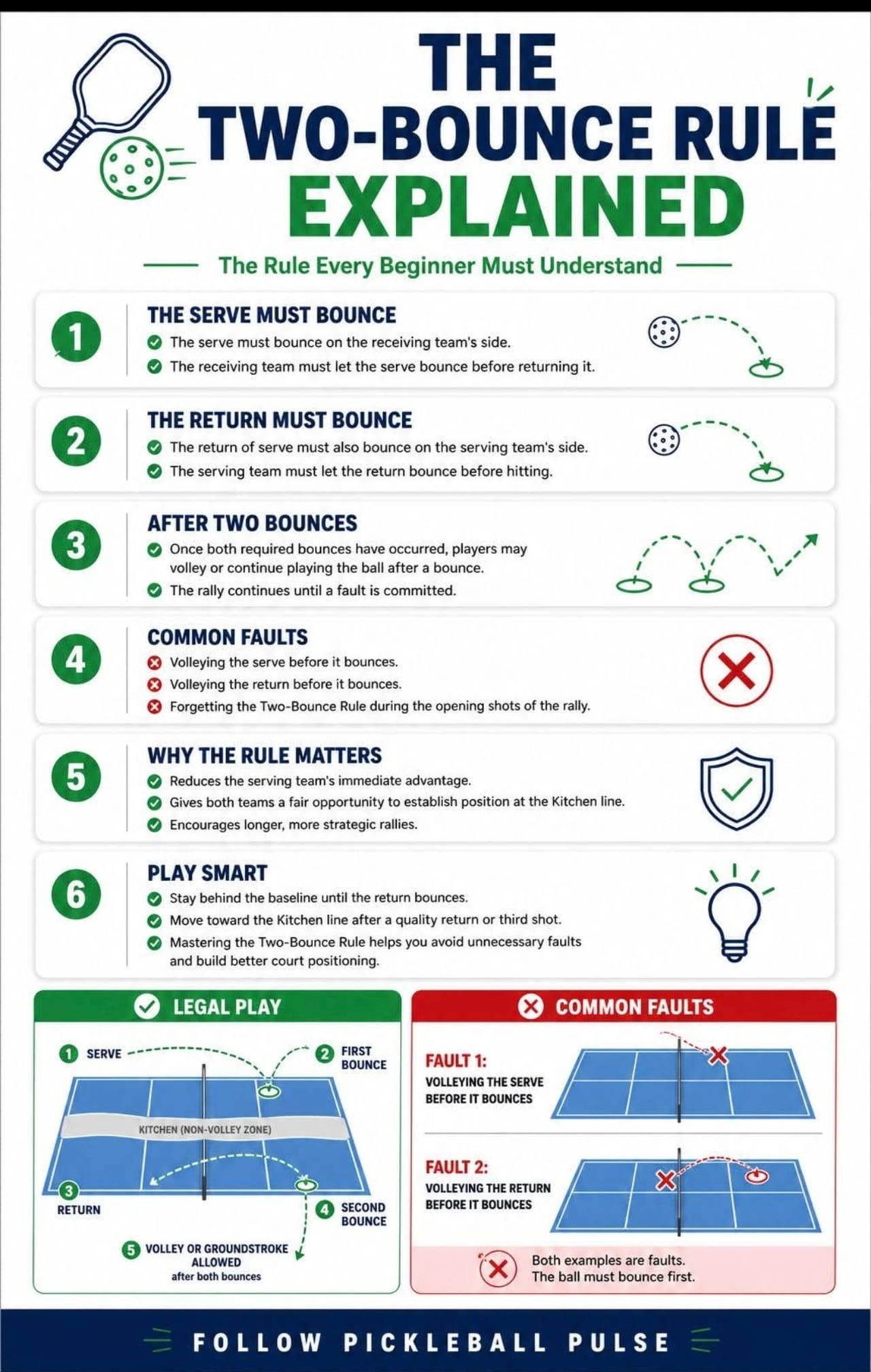
The Two-Bounce Rule is one of the foundational rules of pickleball, yet it frequently causes confusion for new players transitioning into the game. Mastering this single rule is essential to avoiding immediate penalties and controlling the rhythm of the rally.
Understanding how the Two-Bounce Rule works will dramatically improve your tactical positioning during the opening sequence of every point.
1. The Serve Must Bounce
When the server hits the ball across the net, it must bounce once inside the receiving team’s service court. The receiving player cannot hit the ball out of the air (volley) on the serve return.
2. The Return Must Bounce
After the returner hits the ball back across the net, the serving team must also let the ball bounce once before hitting it. This is why the serving team remains near the baseline for the second shot of the rally.
3. Freedom After Two Bounces
Once both required bounces have occurred (the serve bounce and the return bounce), players on either side are free to either volley the ball out of the air or play it after a bounce.
4. Common Faults to Avoid
The most frequent mistakes made by beginners include volleying the serve out of the air, rush-charging the kitchen on serve, and volleying the return of serve before it bounces on the serving side.
5. Why the Rule Matters
This rule exists to neutralize the immediate serving advantage found in games like tennis. It forces both teams onto equal footing, encouraging longer, more tactical exchanges at the Kitchen line.
6. Play Smart Strategy
If you are serving, stay patient behind the baseline until the return bounces. Once you execute a quality third-shot drop or drive, transition cleanly forward toward the Kitchen line.