
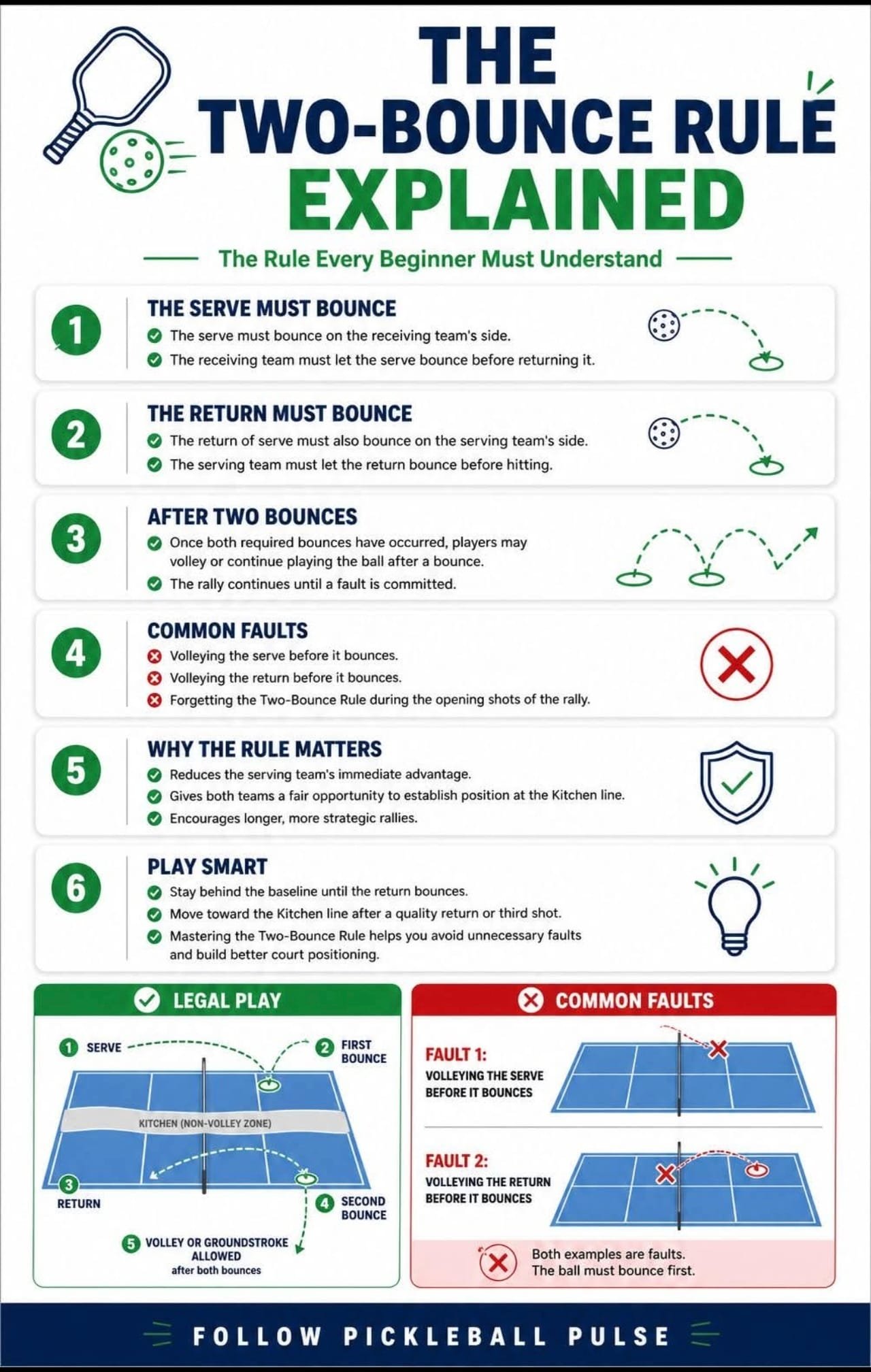
The Two-Bounce Rule is the foundational rule that gives pickleball its unique rhythm and strategic depth. Designed to prevent the serving team from rushing the net immediately, mastering this rule avoids automatic faults during opening rally exchanges.
Here is a complete breakdown of how the rule works and why it shapes court tactics.
1. The Serve Must Bounce
When a serve crosses the net, it must bounce inside the receiving team’s court bounds. The receiver must let the ball bounce before striking their return.
2. The Return Must Bounce
After the receiver hits their return shot, the serving team must also allow the ball to bounce on their side before striking shot number three.
3. After Two Bounces
Once both required bounces have taken place, players are free to hit volleys out of the air or continue playing off the bounce until the point ends.
4. Common Faults to Avoid
The most common beginner mistakes include hitting a volley directly off the incoming serve or rushing forward to volley the return before it bounces on the serving side.
5. Why the Rule Matters
This rule levels the playing field by removing serve-and-volley dominance, giving receivers a fair chance to claim net position while encouraging tactical rallies.
6. Play Smart
Serving teams should stay behind the baseline until the return bounces, using a soft third-shot drop to earn safe passage forward to the Kitchen.