
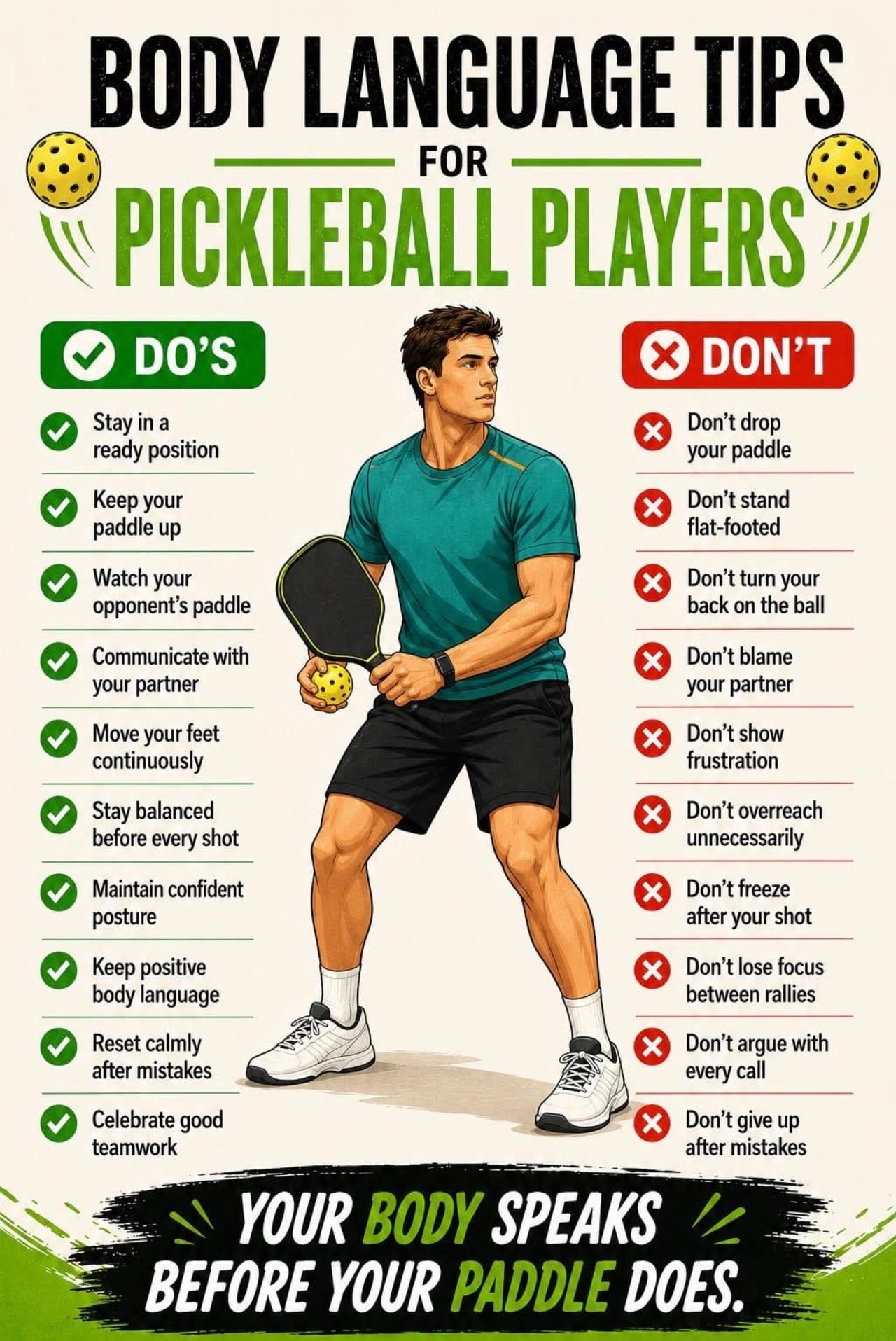
In competitive pickleball, your posture and physical movement send non-verbal signals to both your opponents and your partner long before the ball contacts your paddle. Dynamic, active body language keeps your nervous system engaged and ready to react, while passive or defeated posture signals weakness and slows your reaction timing.
The Power of Positive Body Language (DO’s)
Mastering correct physical presence on the court ensures speed, balance, and positive team dynamics:
- Stay in a ready position: Keep knees bent, weight balanced on the balls of your feet, and posture centered to react explosively to fast attacks.
- Keep your paddle up: Maintain a chest-high paddle position with an extended contact zone so you are always primed for firefights at the kitchen line.
- Watch your opponent’s paddle face: Track your opponent’s backswing and paddle angle to anticipate shot direction and pace ahead of impact.
- Communicate actively with your partner: Use clear verbal calls like “mine,” “yours,” or “out” alongside non-verbal cues to prevent middle-court confusion.
- Move your feet continuously: Maintain active split-steps and micro-adjustments rather than standing static as the ball travels across the net.
- Maintain balanced posture before every shot: Establish set footwork before initiating your swing to ensure maximum control and accuracy.
- Reset calmly after mistakes: Stand tall, shake off errors immediately, and maintain projectable composure to keep match momentum stable.
Body Language Mistakes to Avoid (DON’Ts)
Eliminate these critical physical mistakes that drain energy and give opponents an immediate edge:
- Don’t drop your paddle: Letting your paddle drop below waist height between shots increases reaction time and leaves you vulnerable to quick speed-ups.
- Don’t stand flat-footed: Resting on your heels limits lateral quickness and prevents quick positioning for third-shot drops and kitchen resets.
- Don’t turn your back on the ball: Always keep eyes and chest oriented toward the action, even when retrieving deep lobs or resetting defense.
- Don’t project frustration or blame: Slumping shoulders, shaking your head, or looking outward during mistakes degrades partner trust and gives opponents psychological momentum.
- Don’t freeze post-shot: Avoid watching your own shot from a static standing position; immediately recover to ideal court positioning following ball impact.
Remember: your body speaks before your paddle does. Adopting an athletic, composed physical presence elevates your personal execution and establishes court control.