
Nothing is more frustrating at the kitchen line than attempting a soft dink only to watch the ball pop up high over the net, giving your opponent an effortless overhead smash. Understanding the bio-mechanical causes of high dinks is the first step toward building a bulletproof soft game.
The 3 Major Causes of Dinking Pop-Ups
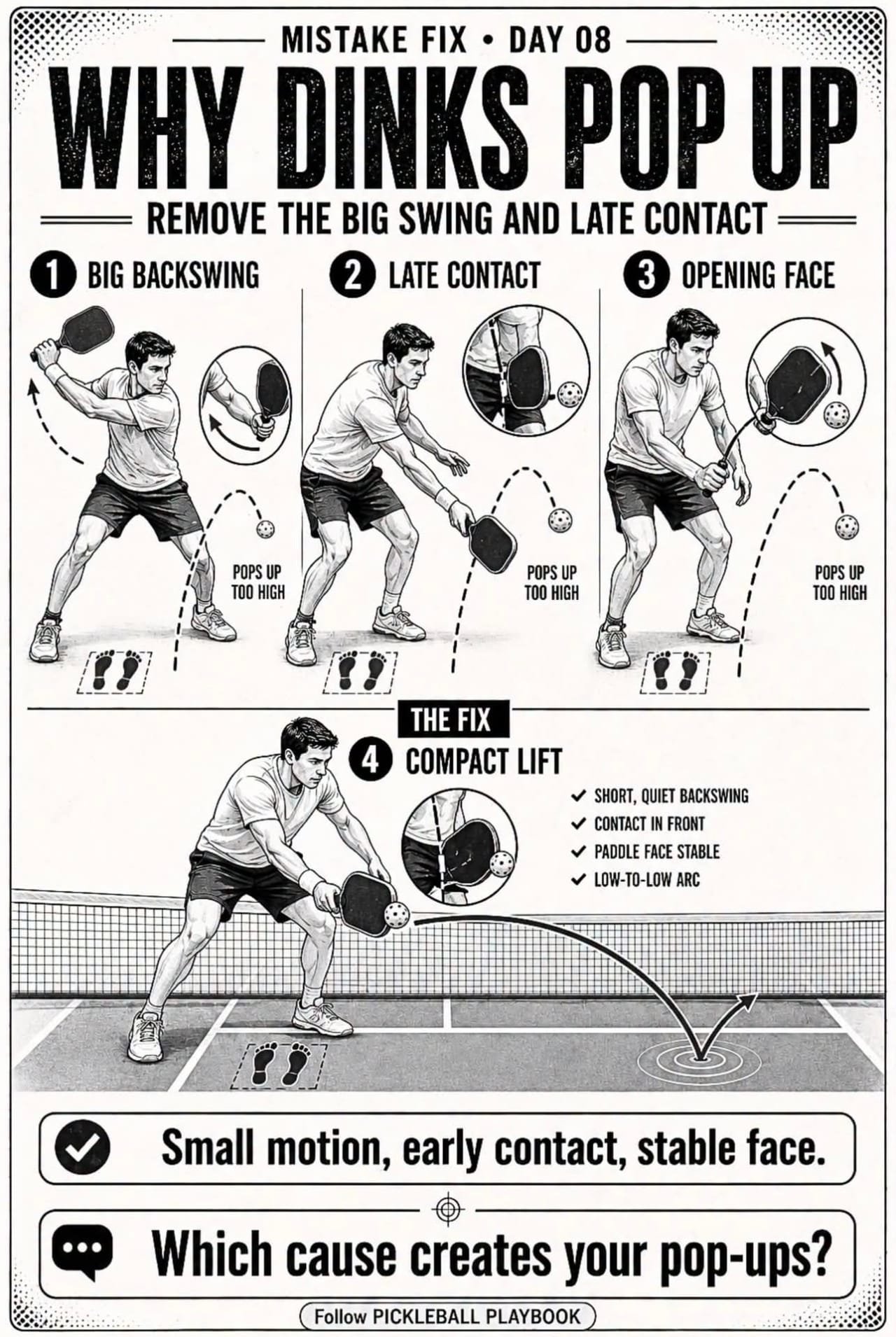
Pop-ups are rarely random accidental errors; they are direct results of specific swing mechanical flaws:
- 1. Excessive Backswing: Taking a large tennis-style backswing behind your hips generates uncontrolled speed and momentum, making delicate soft contact nearly impossible.
- 2. Late Contact Point: Allowing the ball to travel behind your front foot before striking forces you to scoop upward awkwardly, lifting the trajectory high over the net.
- 3. Opening the Paddle Face Prematurely: Tilting your paddle face skyward at an extreme upward angle converts forward control into pure vertical loft.
The Fix: Master the Compact Lift Technique
To produce low, un-attackable dinks that land short in the opponent’s kitchen, replace large swinging motions with a compact, controlled push motion:
- Short, quiet backswing: Start with your paddle already positioned out in front of your chest. Eliminate any rearward motion.
- Contact early and in front: Strike the ball 6 to 12 inches in front of your lead shoe to maintain full visual tracking and trajectory control.
- Keep paddle face angle stable: Maintain a neutral or slightly open paddle face throughout contact without flicking your wrist.
- Low-to-low arc path: Push gently through the ball using your legs and shoulder joint rather than hinging at the elbow or wrist.
By keeping your motion compact and hitting early out in front, you transform pop-ups into un-attackable kitchen drops.